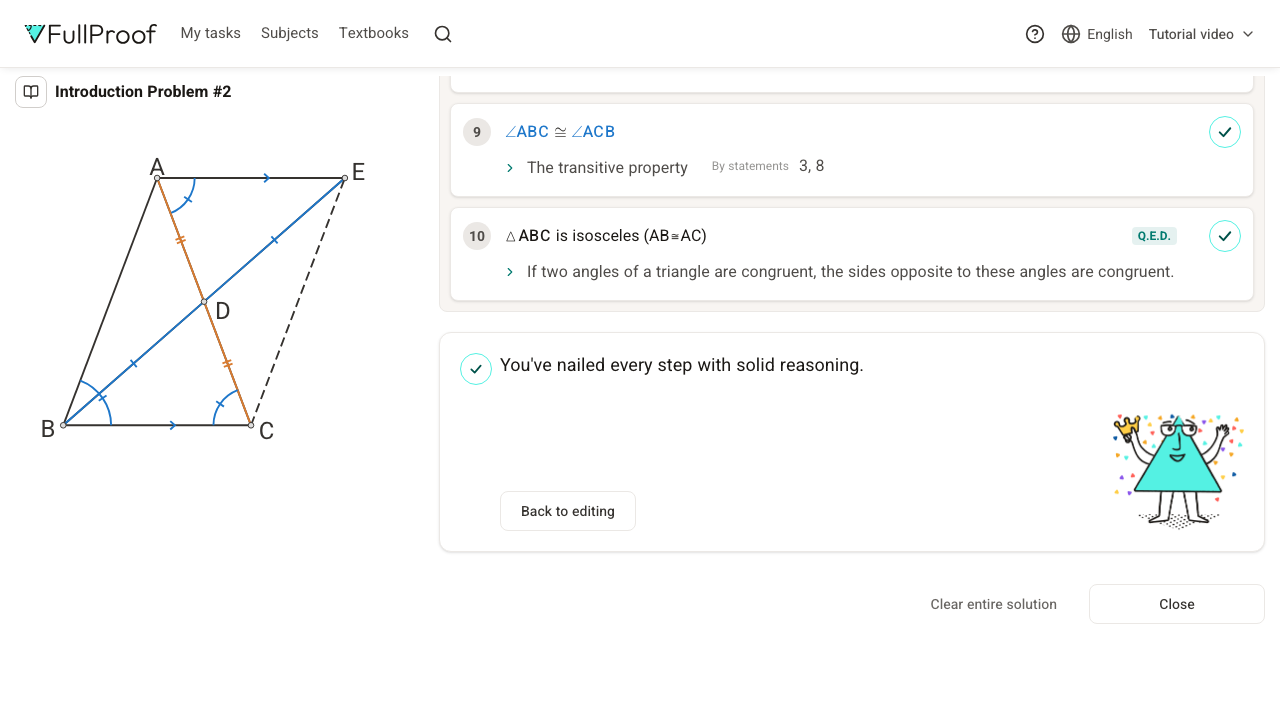
Solving intro question 2 (grades 10–11), step by step
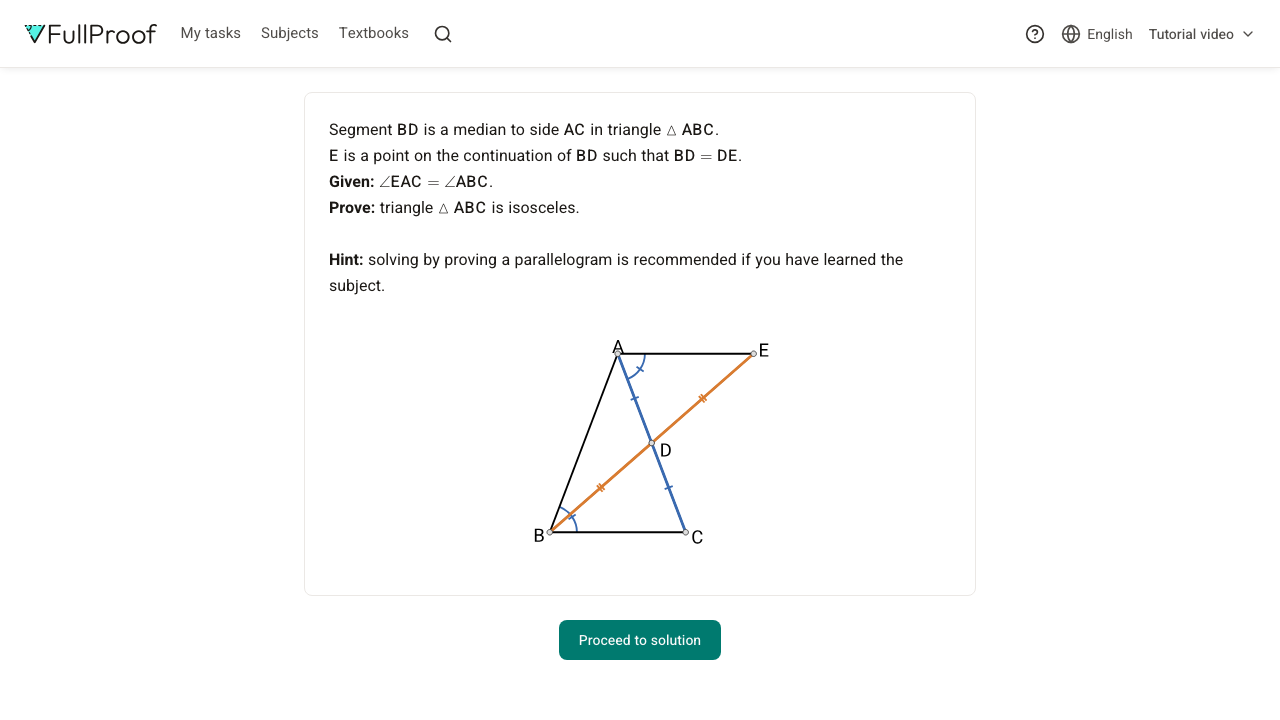
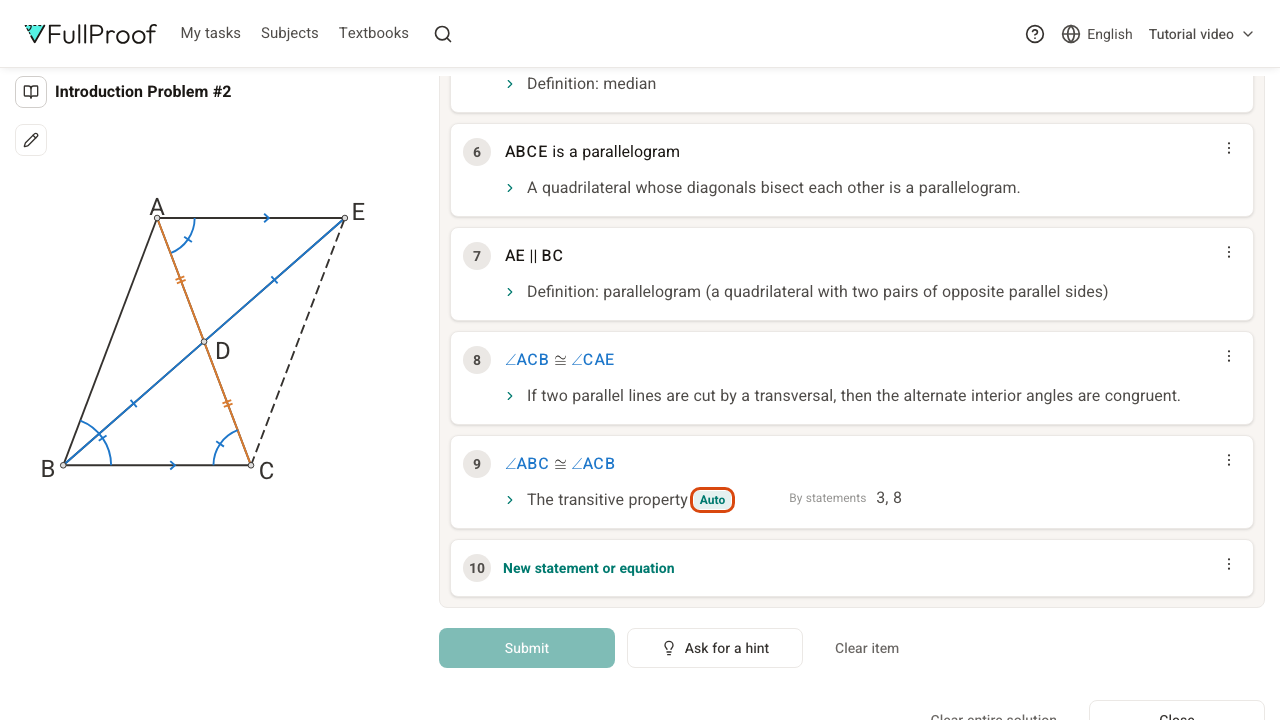
There are several ways to solve this question. Here we solve it with a parallelogram, and for that we add an auxiliary segment to the diagram.
The givens already appear in the proof as steps 1–3. The second and third givens, BD ≅ DE and ∠ABC ≅ ∠CAE, are already equalities — you can use them as they are, without writing them again.
Add the segment CE to the diagram
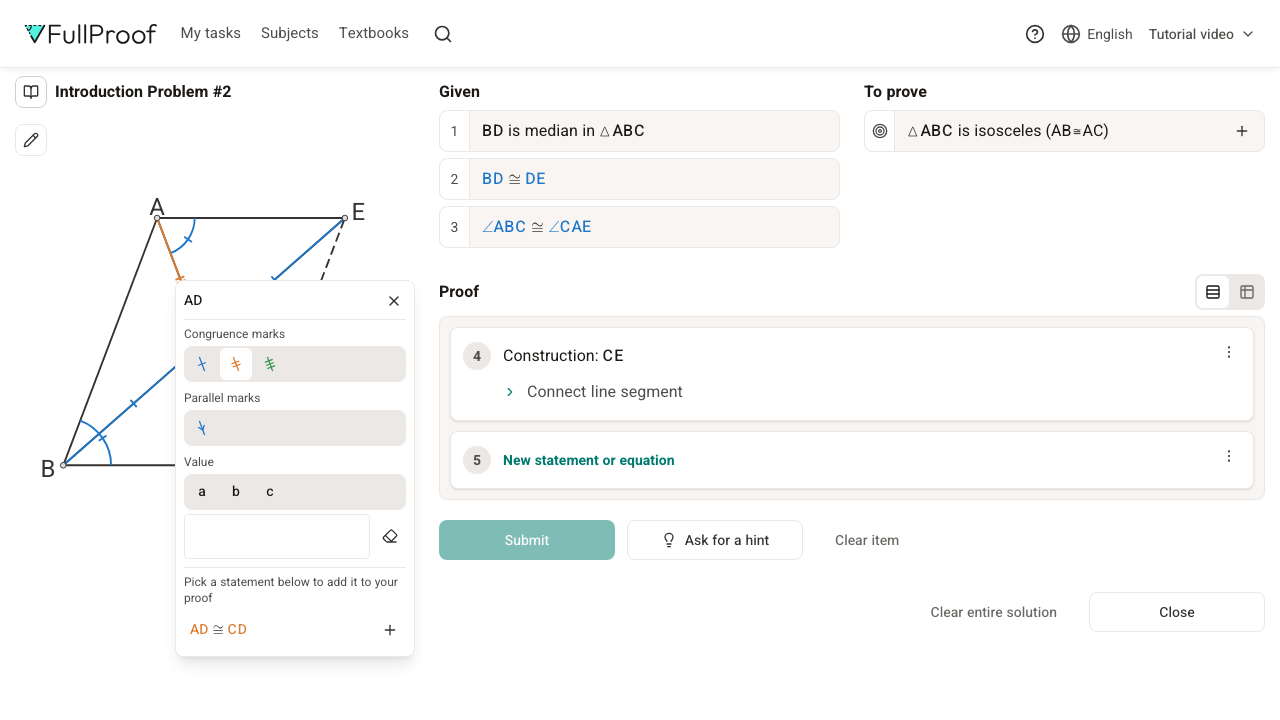
Click the Constructions button (the pencil above the diagram), choose Connect line segment between two points, and click the points C and E. The segment appears on the diagram as a dashed line, and is added to the proof too, as the row Construction: CE, with its reason, Connect line segment, already filled in.
Add the statement AD ≅ CD
This statement follows from the first given: BD is the median to side AC. Give both segments CD and AD the same mark on the diagram. The mark with one tick is already taken (BD ≅ DE), so choose 2 ticks. Once the second segment is marked too, the marking menu suggests the statement AD ≅ CD — click it to add it to the proof. The reason: Definition: median.
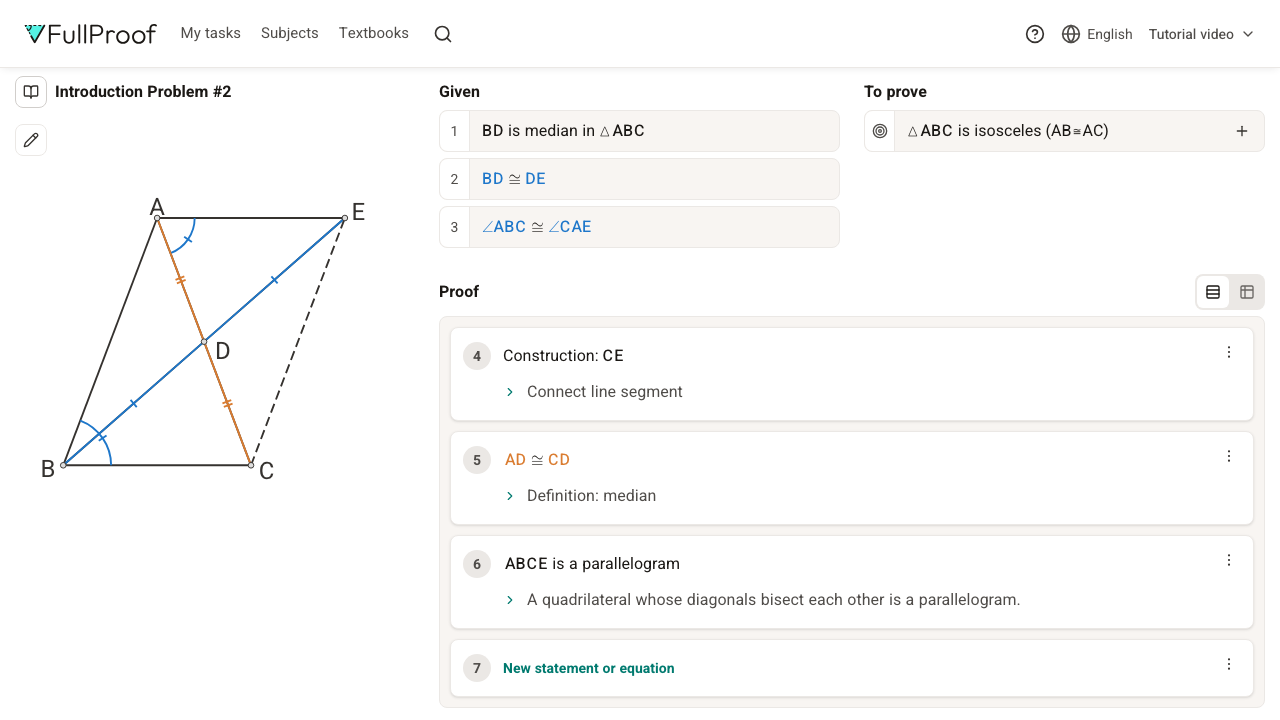
Add the statement that ABCE is a parallelogram
Point D is the midpoint of both diagonals of quadrilateral ABCE: of AC (the previous row) and of BE (the second given). Click New statement or equation, search for "parallelogram", and choose the quadrilateral ABCE. The reason: A quadrilateral whose diagonals bisect each other is a parallelogram.
Add the statement that AE is parallel to BC
Click New statement or equation, and at the top of the window click the Parallel Lines shortcut. Choose both segments. The reason: Definition: parallelogram (a quadrilateral with two pairs of opposite parallel sides).
Add the statement that angle ACB is congruent to angle CAE
The parallel lines AE and BC are cut by AC, so the alternate angles ACB and CAE are congruent. Click angle ACB on the diagram and give it the blue mark of the given angles (an arc with 1 tick). The marking menu now suggests two statements: ∠ACB ≅ ∠CAE and ∠ABC ≅ ∠ACB. Click the first one to add it to the proof. The reason: If two parallel lines are cut by a transversal, then the alternate interior angles are congruent. — search for "alternate".
Add the statement that angle ABC is congruent to angle ACB
Both angles are congruent to angle CAE: angle ABC by the third given, and angle ACB by the previous row. Click angle ACB on the diagram again, and add the second statement the marking menu suggests. The app fills in the reason by itself: Transitivity, tagged Auto.
Add the statement to prove
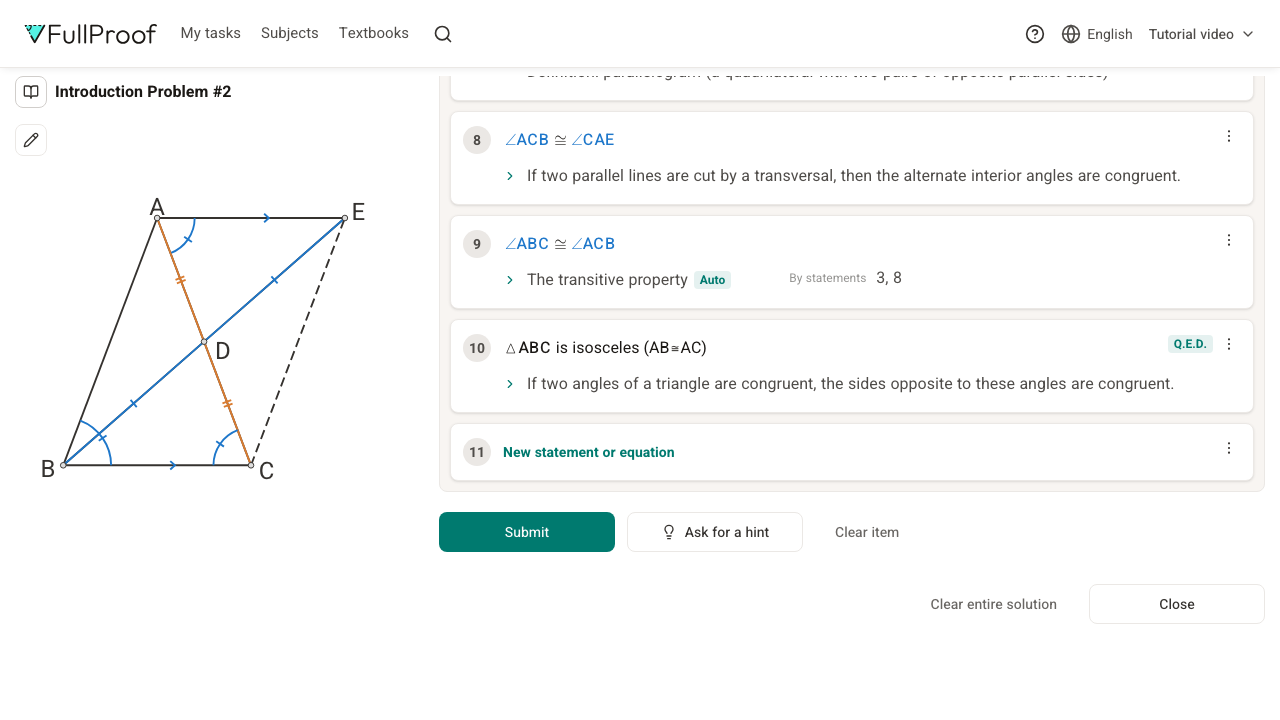
Click the + sign next to it at the top of the question, and add the reason If two angles of a triangle are congruent, the sides opposite to these angles are congruent. — search for "sides opposite".
Submit the solution
Click Submit. If the solution has mistakes, click Fix the proof and correct them, until every row is marked ✓ and a message says the proof is complete and every step is justified.